

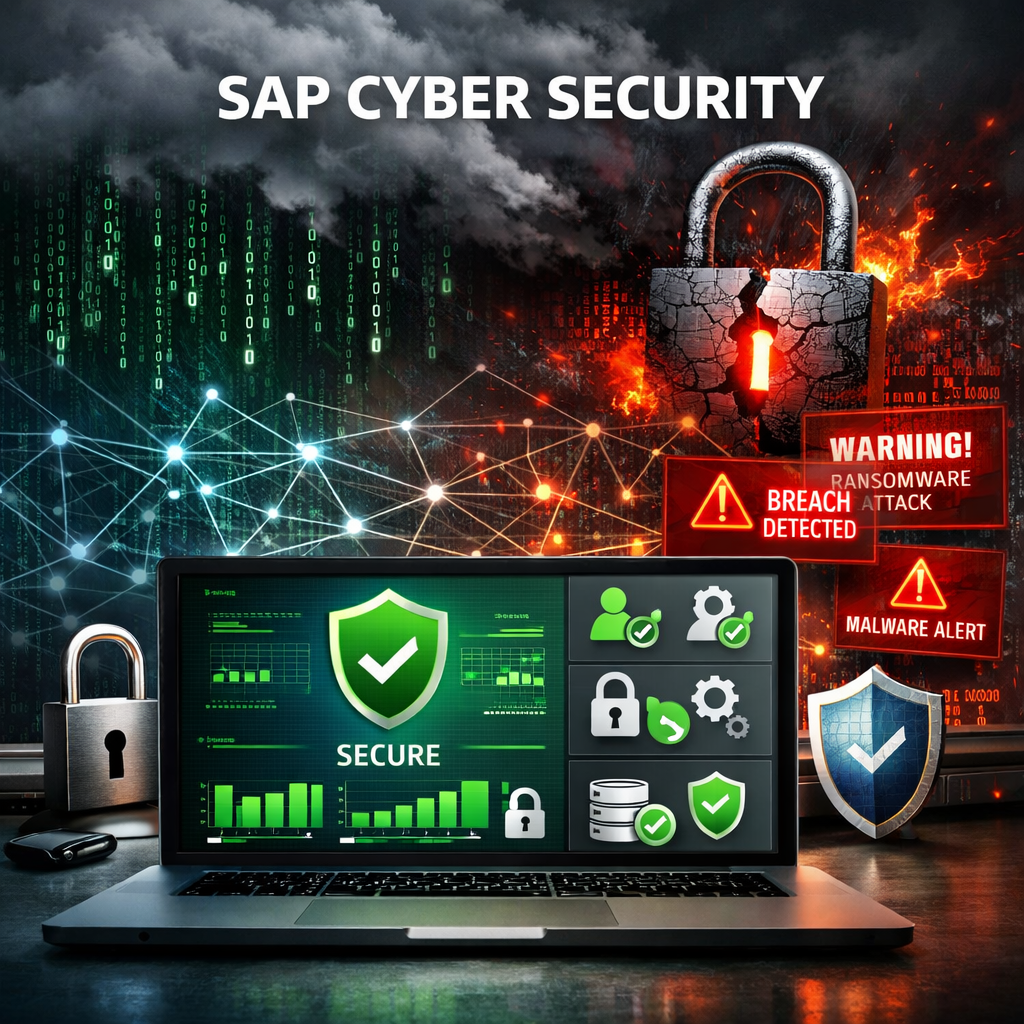
Your GRC dashboard shows green. Segregation of duties violations are at zero. Role assignments follow least-privilege principles. Your auditors signed off last quarter.
Then ransomware encrypts your HANA database.
The attackers never touched your authorization layer. They exploited an unpatched kernel vulnerability. They entered through the operating system. Your carefully designed role matrix was irrelevant.
This is the gap between SAP Security and SAP Cyber Security. Most organizations have the first. Few have the second.
Defining the Difference: GRC vs. Cyber Security
The terms “SAP Security” and “SAP Cyber Security” sound similar. They address different threats using different approaches.
SAP Security (Classic)
Traditional SAP security focuses on who can do what inside SAP:
- Roles and Authorizations: Which users access which transactions
- Segregation of Duties (SoD): Preventing toxic combinations of access
- GRC (Governance, Risk, Compliance): Monitoring and enforcing access policies
- User Administration: Provisioning, deprovisioning, access reviews
This layer answers one question: “Is this user allowed to perform this action?”
The focus is internal. The threat model assumes authenticated users attempting unauthorized business activities. A warehouse clerk trying to approve their own purchase orders. A contractor accessing salary data outside their scope.
GRC tools excel at preventing internal fraud. They are the ID card reader at the door.
SAP Cyber Security (Modern)
SAP cyber security focuses on external threats trying to compromise SAP:
- Vulnerability Management: Identifying and patching security weaknesses
- Threat Detection: Monitoring for attack signatures and anomalies
- Hardening: Configuring systems to minimize attack surface
- Incident Response: Detecting and containing active attacks
This layer answers different questions: “Is someone trying to break in? Has something been compromised? Are we configured securely?”
The focus is external. The threat model assumes sophisticated attackers targeting your systems from outside. Ransomware operators scanning for vulnerable SAP systems. Nation-state actors exploiting zero-day vulnerabilities. Automated botnets probing for unpatched kernels.
Cyber security tools are the armed guard and the CCTV. They detect threats that ID cards cannot stop.
The Definition Gap
|
Aspect |
SAP Security (GRC) |
SAP Cyber Security |
|
Primary Threat |
Internal fraud |
External attacks |
|
Focus |
Who can do what |
What is attacking us |
|
Controls |
Roles, authorizations, SoD |
Patches, hardening, detection |
|
Tools |
GRC platforms, IDM |
Vulnerability scanners, SIEM |
|
Owner |
SAP Security team |
InfoSec/SOC + Basis |
|
Audit Scope |
Access compliance |
Threat posture |
Organizations need both layers. GRC without cyber security leaves the front door locked while the back window stays open. Cyber security without GRC protects against hackers but not insider threats.
The New Threat Landscape for SAP
SAP systems contain the data attackers want: financial records, customer information, intellectual property, supply chain data. The threat landscape has evolved beyond internal misuse.
Ransomware Targets SAP Directly
Modern ransomware campaigns specifically target SAP databases. The attackers understand that encrypting your HANA database stops your business operations. They know companies will pay to recover.
Ransomware enters through multiple vectors:
- Unpatched operating systems: Windows Server or Linux vulnerabilities
- Exposed SAP services: RFC, HTTP, or database ports accessible from internet
- Compromised credentials: Stolen passwords used to authenticate
- Supply chain attacks: Compromised third-party software with SAP access
The ransomware executes at the OS level. It encrypts files on disk. Your role matrix cannot prevent file encryption. Your authorization object checks never fire because the attack bypasses the application layer entirely.
The Log4j Warning
The Log4j vulnerability demonstrated how quickly SAP environments become targets. A critical vulnerability in a common Java library affected SAP systems worldwide. Attackers scanned the internet for vulnerable instances within hours of public disclosure.
Organizations with mature vulnerability management identified affected systems quickly. They applied patches or workarounds before exploitation. Organizations without this capability scrambled to inventory their exposure.
Log4j was one vulnerability. SAP releases security notes monthly. SAP HotNews patches address critical vulnerabilities that attackers actively exploit. Without systematic vulnerability management, each month increases your attack surface.
Why Hackers Target SAP
SAP systems make attractive targets for several reasons:
- High Value Data: Financial transactions, pricing, customer records
- Business Criticality: Downtime costs millions per hour
- Complex Patching: Many organizations delay patches due to testing requirements
- Limited Monitoring: SOC teams often lack SAP visibility
- Stable Attack Surface: SAP versions remain deployed for years
Attackers research SAP vulnerabilities extensively. They know which kernel versions contain which bugs. They know which profile parameters create exposure. They build automated tools that scan for these weaknesses at scale.
Key Components of an SAP Cyber Defense Strategy
Effective SAP cyber security requires three interconnected capabilities. Each addresses a different phase of the attack lifecycle.
Component 1: Vulnerability Management
Vulnerability management means patching before the exploit. You cannot defend against attacks that target weaknesses you haven’t fixed.
SAP Kernel Patching
The SAP kernel contains critical vulnerabilities that SAP patches regularly. Kernel upgrades should follow a predictable cadence. Automated analysis of SAP HotNews helps prioritize which patches demand immediate attention.
Operating System Patching
SAP runs on operating systems that require their own patching. A fully patched SAP application on an unpatched Windows Server remains vulnerable. Vulnerability management must span both layers.
Patch Status Visibility
You cannot patch what you cannot see. Vulnerability management requires continuous visibility into:
- Current kernel and support package versions
- Missing SAP security notes
- OS patch levels across all SAP servers
- Third-party component versions (Java, browser plugins, etc.)
Component 2: Threat Detection
Vulnerability management prevents known attacks. Threat detection catches attacks in progress, including those exploiting unknown vulnerabilities.
Configuration Change Monitoring
Attackers modify system configurations to establish persistence or escalate privileges. Security parameter monitoring detects unauthorized changes to:
- Profile parameters affecting security
- ICM configuration (web exposure)
- RFC destination settings
- User master records (especially SAP* and DDIC)
Anomaly Detection
Some attacks do not trigger specific signatures. Anomaly detection identifies unusual patterns:
- Failed login attempts across multiple systems
- Unusual RFC call patterns
- Mass data exports
- After-hours administrative activity
Log Analysis
SAP generates detailed logs that contain attack evidence. SM21 system logs, security audit logs, and gateway logs record events that indicate compromise. Most organizations do not analyze these logs systematically.
Component 3: Hardening
Hardening reduces attack surface by configuring systems to minimize exposure.
Profile Parameter Hardening
SAP systems ship with default configurations that prioritize compatibility over security. Security hardening adjusts profile parameters to:
- Disable unnecessary services
- Enforce password complexity
- Restrict remote access methods
- Enable security logging
Network Segmentation
SAP systems should not be directly accessible from the internet. Proper network architecture limits exposure:
- RFC only from trusted sources
- HTTP/HTTPS through reverse proxies
- Database ports never externally accessible
- Jump hosts for administrative access
Secure Defaults
Hardening includes removing or securing default accounts (SAP*, DDIC, SAPCPIC), disabling sample applications, and removing unnecessary ICF services. Each enabled service represents potential attack surface.
Bridging the Gap: How Basis and InfoSec Must Collaborate
SAP cyber security falls into an organizational gap. The SOC handles enterprise security but lacks SAP expertise. The Basis team handles SAP but lacks security operations integration.
The Silo Problem
In most organizations:
- Basis Team: Manages SAP technical configuration. Understands profile parameters, kernel versions, and SAP-specific threats. Lacks integration with enterprise SIEM and incident response processes.
- SOC (Security Operations Center): Monitors enterprise threats. Runs Splunk, Sentinel, or other SIEM platforms. Investigates alerts and coordinates incident response. Is blind to SAP-specific threats because SAP doesn’t feed their tools.
The result: SAP threats exist in a blind spot. The people who could detect them lack SAP knowledge. The people with SAP knowledge lack detection tools.
Translating SAP to SOC
Bridging this gap requires translation. SAP generates security-relevant events in SAP-specific formats. The SOC needs these events in their language and their tools.
Effective integration includes:
SIEM Integration
SAP security events should flow to your enterprise SIEM (ServiceNow, Splunk, Microsoft Sentinel, etc.). This puts SAP alerts alongside network, endpoint, and cloud alerts. The SOC sees the complete picture.
Alert Translation
Raw SAP events require context. “Profile parameter login/fails_to_user_lock changed from 5 to 99” means nothing to a SOC analyst. “Password brute force protection disabled on production SAP system” triggers appropriate urgency.
Avantra translates SAP technical events into security-relevant alerts that SOC teams understand. The output speaks SOC language, not SAP language.
Unified Dashboards
Security posture should be visible in one place. SAP vulnerability status, hardening compliance, and threat alerts should appear alongside other enterprise security metrics.
Shared Ownership Model
Effective SAP cyber security requires collaboration:
|
Function |
Basis Team |
InfoSec/SOC |
|
Patch identification |
Lead |
Consult |
|
Patch testing |
Lead |
Review |
|
Patch deployment |
Lead |
Verify |
|
Hardening standards |
Consult |
Lead |
|
Hardening implementation |
Lead |
Audit |
|
Threat detection rules |
Consult |
Lead |
|
Alert triage |
Support |
Lead |
|
Incident response |
Support |
Lead |
Neither team owns SAP cyber security alone. The Basis team brings SAP expertise. InfoSec brings security methodology. Together they close the gap.
Avantra’s Role: The Cyber Layer Under GRC
GRC platforms manage the authorization layer. They answer “who can do what.” They do not address “are we vulnerable” or “are we under attack.”
Avantra provides the cyber layer that sits underneath GRC:
Vulnerability Visibility
Continuous monitoring of kernel versions, patch levels, and security note applicability. You see what needs patching across your entire landscape.
Hardening Compliance
Automated checks against security baselines. Deviations trigger alerts. Configuration drift becomes visible before it becomes exploitable.
Threat Detection
Real-time monitoring of security-relevant changes and anomalies. Suspicious activity surfaces immediately, not during the next audit.
SOC Integration
SAP security events translated into SOC-ready alerts. Integration with SIEM platforms puts SAP visibility where your security team works.
The combination of GRC (permissions) and Avantra (defense) provides complete security coverage. One without the other leaves gaps attackers will find.
Conclusion: Security Is a Team Sport
SAP cyber security is not an upgrade to your GRC program. It is a separate discipline addressing separate threats.
GRC prevents internal fraud. Cyber security prevents external attacks. Both are necessary. Neither is sufficient alone.
The organizations that protect their SAP systems effectively share common characteristics:
- They distinguish GRC from cyber security. Different teams, different tools, different metrics.
- They patch systematically. Kernel updates, security notes, OS patches follow predictable schedules.
- They harden proactively. Configuration baselines exist. Deviations trigger alerts.
- They detect threats. Monitoring covers not only application uptime but security events.
- They integrate SAP into enterprise security. The SOC sees SAP. Incident response includes SAP.
Your GRC dashboard can show green while attackers move through your systems. Don’t let the green lights create false confidence.
Build both layers. Secure permissions with GRC. Secure systems with cyber defense. Protect your SAP landscape from threats that never touch your role matrix.
4. FAQs
Q: What is the difference between SAP Security and SAP Cyber Security?
A: SAP Security (classic) focuses on roles, authorizations, GRC, and segregation of duties. It prevents internal fraud by controlling who can do what. SAP Cyber Security focuses on vulnerability management, threat detection, and hardening. It prevents external attacks like ransomware by securing the system against exploitation.
Q: Can ransomware bypass SAP authorization controls?
A: Yes. Modern ransomware targets the operating system and database directly. It encrypts files at the OS level without authenticating to the SAP application. Your role matrix is irrelevant when the attack never enters the authorization layer.
Q: Why do SOC teams often miss SAP threats?
A: SOC teams typically lack SAP expertise and their monitoring tools (SIEM) receive limited SAP data. Basis teams understand SAP but lack integration with security operations. This creates a blind spot where SAP-specific threats go undetected.
Q: What is SAP HotNews and why does it matter for cyber security?
A: SAP HotNews are critical security notes addressing actively exploited vulnerabilities. They require immediate attention. Automated analysis of HotNews patches helps organizations identify and remediate critical vulnerabilities before attackers exploit them.
Q: How does Avantra complement GRC platforms?
A: GRC platforms manage the authorization layer (who can do what). Avantra provides the cyber layer underneath: vulnerability visibility, hardening compliance, threat detection, and SOC integration. Together they cover both internal fraud prevention and external attack defense.
Q: Should Basis teams or InfoSec own SAP cyber security?
A: Neither team alone. SAP cyber security requires collaboration. Basis teams bring SAP technical expertise for patching and hardening implementation. InfoSec brings security methodology for detection rules, incident response, and SIEM integration. Shared ownership closes the gap between disciplines.