


Rapid Installation and Onboarding New Systems

Industry Best Practices, Right Out of the Box

Flexible Workflow Automation Engine
Rapid Installation and Onboarding New Systems
Auto-discovery with best-practice SAP management applied automatically
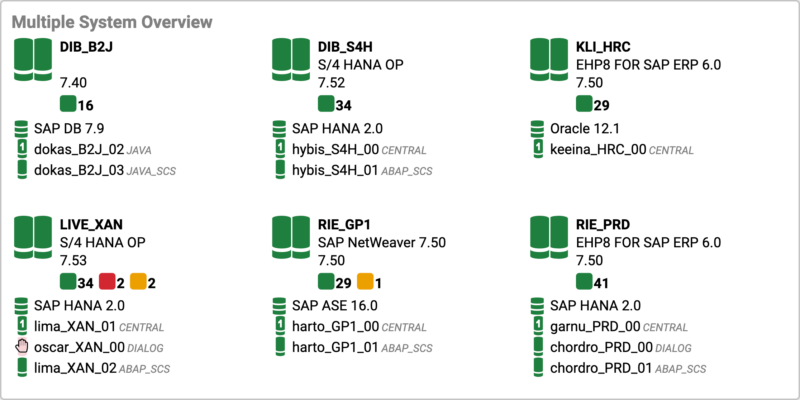
Avantra is live in days, with no consultants, long-running projects, six-figure engagements, or manual configuration required. Once installed, the Avantra agent automatically identifies the various SAP system elements and versions, then tailors monitoring and alerts to the exact OS, DB, and SAP components of each system. When new systems come online, Avantra quickly identifies their components as well, seamlessly adding them into the overall solution. Migros, Switzerland’s largest retailer, implements server updates in 1 to 2 hours with Avantra and cut post-processing of system copies from 3 hours to 3 minutes (read the Migros case study).

Industry Best Practices, Right Out of the Box
Leverage our decades of experience with SAP best practices, automatically.
Not only does Avantra automatically discover every component in your SAP systems, it automatically applies to each of those components the appropriate monitoring from a library of 300+ built-in checks. It then configures each check for best-practice thresholds, so that your monitoring is up and running with minimal need for manual configurations. Of course, your Basis team can also use Avantra to tune these thresholds over time or easily add custom checks to address your landscape’s unique needs.
Flexible Workflow Automation Engine
Automate complex manual sequences to control and manage your SAP landscapes.
While Avantra provides sophisticated monitoring for all your SAP systems and components, its flexible workflow automation engine allows you to script and automate interactions with those components. Far beyond simply stopping and starting systems at a scheduled time, which is useful for maintenance windows, Avantra also allows you to run operating system-level commands, interact with SAP components, pause or wait until a system check has a specific result, and more. You can define entire sequences of actions with conditional logic to control and manage your SAP systems.
For patch automation, see Patching & Security.

Catch failed SAP transports before users do
Avantra monitors SAP transport imports across every system in the landscape, alerting on failed imports in near real time and flagging transports imported by their own owner.
Four built-in checks cover the transport path:
- Failed imports, in near real time. Avantra checks the return code of recent transport imports. A return code of 8 or higher raises a Critical alert, and 4 or higher raises a Warning.
- A daily import review. A daily version of the same check also lists transport requests that haven’t been imported yet, so nothing sits in a queue unnoticed.
- Transport system health. Avantra runs a set of TMS configuration tests on SAP systems from release 7.30 SP5.
- Segregation of duties. Avantra flags transport requests where the same user owned and imported the request, a common audit finding.
An alert doesn’t have to stop at a dashboard. Any check result can open a ServiceNow incident or start an Avantra workflow, so a failed import reaches the right team with its details attached.
Avantra monitors transports alongside SAP ChaRM or a transport management tool. It doesn’t replace them.
Connecting SAP operations to DevOps pipelines
Avantra connects SAP operations to DevOps pipelines through its GraphQL and SOAP APIs, a command-line interface, and outbound REST calls, so pipelines can start Avantra workflows and Avantra can call pipeline tools.
It works in both directions:
- Pipeline to Avantra. A pipeline step can start an Avantra workflow through the API or the command-line interface. Workflows can also start on a schedule, from an alert, or by hand in the Avantra UI.
- Avantra to pipeline. An Avantra notification can call any REST or SOAP endpoint, so a check result can feed back into the tools the DevOps team already uses.
Avantra’s DevOps Automation Makes Growing and Maintaining SAP Landscapes Easy.
Get the info you need to decide if Avantra is right for your SAP landscape.
Real results. Across real landscapes.

“We needed better access to data about critical operations… our engineers were so busy reacting to day-to-day urgency, we had to outsource more strategic activities…”

“By using Avantra, we have been able to prevent serious failures in our SAP production systems. Today, we only need 1 to 2 hours to install server updates, we have been…”
SAP DevOps Automation FAQs
How do I monitor SAP transport failures automatically?
Avantra monitors SAP transport failures automatically by checking the return code of every transport import and alerting on failures in near real time. Return codes of 8 or higher raise a Critical alert, and 4 or higher raise a Warning. Alerts can open a ServiceNow incident or start an automated workflow.
Can Avantra integrate with CI/CD or DevOps pipelines?
Yes. Avantra integrates with CI/CD and DevOps pipelines through its GraphQL and SOAP APIs, a command-line interface, and outbound REST and SOAP notifications. Pipelines can start Avantra workflows, and Avantra check results can call back into pipeline tools.
Does Avantra replace SAP ChaRM or a transport management tool?
No. Avantra monitors transports alongside SAP ChaRM or a transport management tool. It alerts on failed imports, checks transport system health, and flags transports imported by their own owner, while release management stays in the existing tool.
How long does Avantra take to install?
Avantra is live in days, without consultants or a long implementation project. Once installed, the agent automatically discovers each SAP system’s components and applies best-practice checks from a library of 300+ built-in checks.