
If you’ve spent any time in the SAP ecosystem, you know the “Configuration Tax.” It’s that invisible, compounding fee paid in hours, manual effort, and caffeine. SAP teams pay tax every time new systems or integrations are brought under observability and management.
For years, the industry accepted that observability required a heavy initial lift. Changes in monitoring policy or underlying infrastructure triggered additional effort often parallel and size and scope to initial onboarding. Whether it was the labyrinthine setup of SAP Solution Manager, the slightly-less-heavy-but-still-weighty Focused Run, or even the modern Cloud ALM, the story was the same: to get value, you first had to survive the implementation.
With the release of Avantra 26, we’re not just lowering that tax – we’re effectively abolishing it. We’ve reimagined what it looks like to move from a “bare” landscape to a fully managed, automated environment. The goal? From zero to managed in record time.
Metric Miles
The shift to Cloud ERP was supposed to make things easier, but in many ways, it just changed the shape of the complexity. SAP’s Cloud ALM, for example, is designed for cloud-centric customers, and works well for many of them. But for a large enterprise with a mix of legacy, hybrid and in-transition systems, there’s no single way to migrate observability along with the migration of core ERP – they are separate entities.
In that world, each individual metric often requires individual configuration, and every time a system or technical policy changes. There is no “set it and forget it” for a group of a hundred systems. You’re stuck in a loop of clicks, manual entries, and the inevitable human error that follows.
Avantra 26 takes a fundamentally different approach.
Implementation Sprints
The first mile of any observability rollout involves the basics: getting systems connected, agents talking, credentials right, the basic plumbing in place. And it’s where many projects begin to bog down. Avantra 26 introduces a new onboarding experience built into the next-gen UI designed to remove that friction outright. Connectivity tests run instantly. Guided configuration wizards walk operators through the steps that matter and skip the ones that don’t. Whether the system in question is a BTP tenant, a RISE-managed S/4 instance, or a long-standing on-prem ECC stack, the path from “this system exists” to “this system is monitored” is the same intuitive flow. Less setup, more value, from the very first click.
That matters because hybrid is now the default. Customers transitioning off SolMan, partially adopting Cloud ALM, running RISE alongside on-prem, and increasingly leaning on BTP services do not have the luxury of a different onboarding workflow per environment. They need one workflow, full stop. The new experience delivers it.
The Long Run
Onboarding the first system is one problem. Onboarding the hundredth (or thousandth!) and keeping all consistently configured as the landscape changes is a very different one. This is where the per-metric model breaks down, and where Avantra’s approach diverges most sharply from the rest of the field.
Avantra 26 features flexibility around the concepts of policy and templates. Rather than configuring monitoring metric-by-metric and system-by-system, operators define what good looks like once and apply it across logical groups of systems — by tier, by module, by environment, by whatever attribute makes sense for the estate. This capability is dynamic, so when a new system comes online matching criteria, the right configuration is already there. A change to the policy propagates automatically. Drift becomes harder to introduce and easier to detect.
This is not a cosmetic improvement. It is the difference between a configuration tax on the size of the estate and observability easily scaling to meet business needs.
Frictionless Onboarding: The Next-Gen Experience
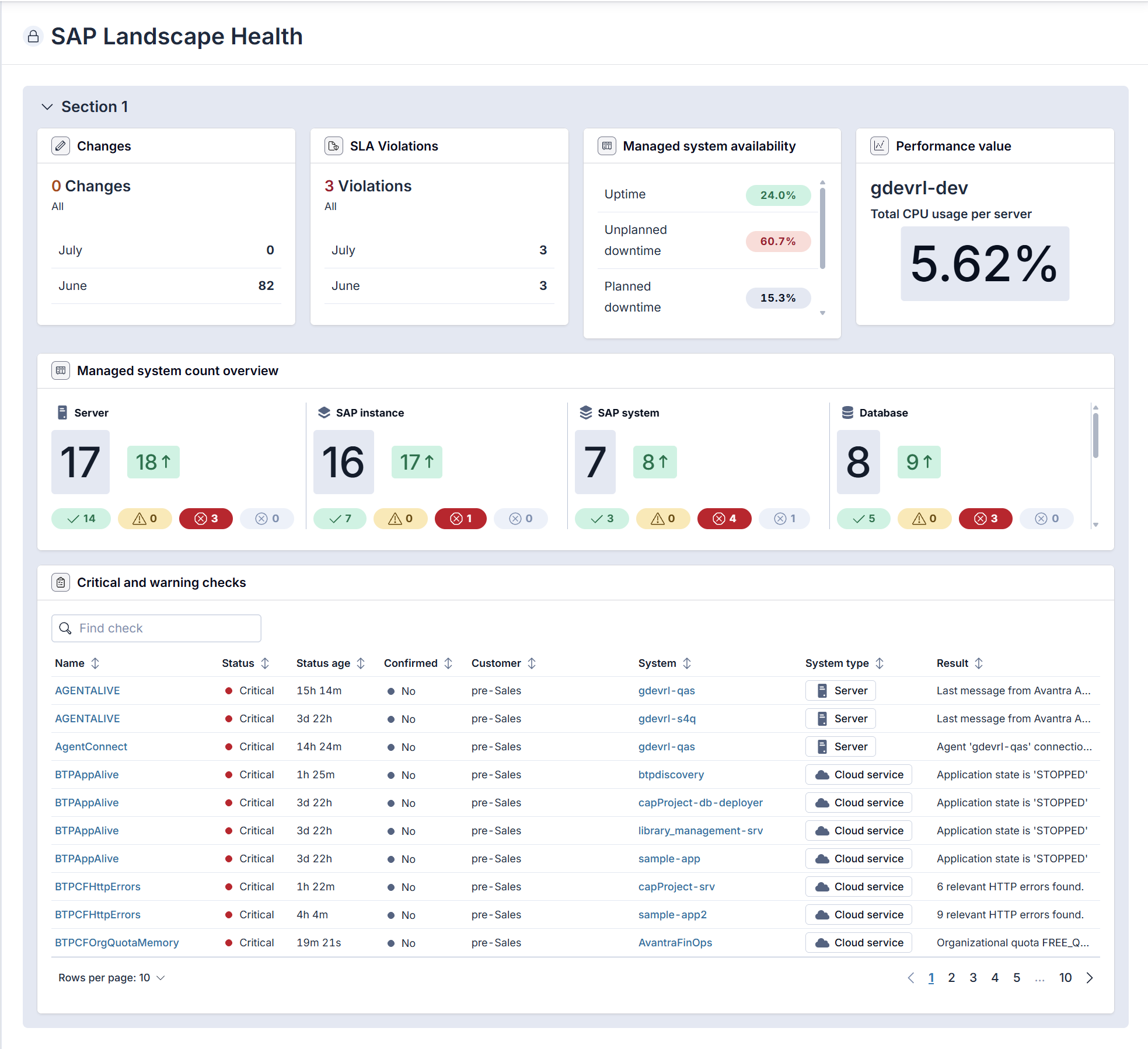
The centerpiece of Avantra 26 is our Next-Gen UI, designed specifically to turn what used to be a specialized technical project into a guided, intuitive experience. Guided configuration wizards eliminate the “which parameters go where?” challenge, simplifying onboarding for BTP tenants, SAP RISE systems, and traditional on-premises landscapes. Unified discovery provides the same management experience anywhere SAP runs. You don’t need three different manuals for three different environments. The result is a “time-to-value” metric measured in minutes vs. weeks: more observability with less setup, starting from the very first click.
The same philosophy carries into the new Avantra 26 automation engine. Authoring automated tasks against SAP has historically required deep, module-specific knowledge, the kind of expertise that lives in a small number of heads and is expensive to scale. The new engine brings Avantra expertise into the tool itself, abstracting much of the SAP-specific complexity out of automation authoring. Operators with broader IT skill sets can now build and run automations that previously demanded a senior basis or solution architect. The result is that automation is getting used, by more people, against more of the estate. And less shelf-ware from automation script breaks at the first need for change.
Transition with Confidence
As the industry moves away from Solution Manager and adopts Cloud ALM, many organizations find themselves managing systems in transition and long-term plans for hybrid operations. Managing observability in this environment requires a flexible bridge between and across these different architectures.
Avantra 26 is that bridge. By providing a single point of control for BTP, RISE, and on-premises, Avantra supports transition without the overhead of disparate, manual tools.
Ready to see it in action? Reach out to your local Avantra expert and explore how Avantra gets customers from Zero to Managed faster than ever before.